- Follow us on
 
|
|
|
|
|
| Social Inclusion and Empowerment « Programmes |
 |
| |
|
| |
| Social Inclusion and Empowerment |
| A two year project for Improving Access to Justice for Dalits in Western Rajasthan supported by UNDP ended in Feb 2012. Currently, there is no financial support dedicated for issue. However, dalits remain the primary target group for all Unnati’s interventions in western Rajasthan and thus support for access to justice and legal redress continues. A minor rape victim from a slum Kutto ka Bara of Jodhpur city was helped with lodging FIR, counseled through stages of police investigation, community support mobilised to pre-empt pressure for compromise and finally linked to Legal Services Authority (LSA) for further legal support in the court. The accused was duly arrested. The block level committee of dalit leaders continue with their monthly meetings in Sivana and Pokhran and undertake due process of fact finding and initial support in cases of atriocities. |
|
| |
| Mainstreaming Disability |
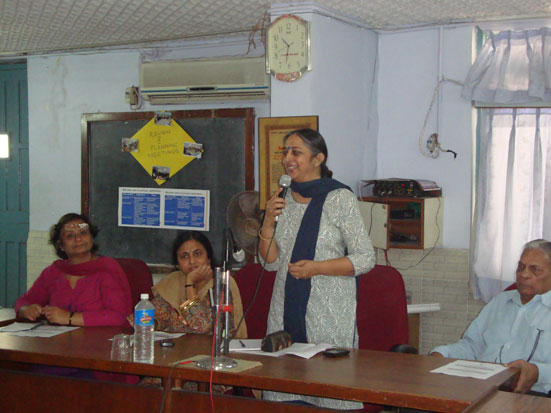
| The seventh and final review meeting of partner organizations was arranged on April 30, 2012. Special educators from all four partner organisations, two of the trustees, mentors, Project Manager of BPA and Unnati team were present for the meeting. The experience of the past three years reveal that Mentors’ support provided by Blind People’s Association (BPA) has helped the special educators in streamlining the documentation process of 180 children with disabilities: maintaining files, intake form, preparing individual education plans (IEPs), assessments, preparing and using time table, getting support from parents, developing meaningful classroom activities, vocational activities, age |
 |
|
| appropriate and functional activities. Capacity building workshop were also organised on sexual problems of adolescents with disabilities, activities of daily living (ADL), teaching learning material (TLM) and an exposure visit to different organisations in Gujarat. A workshop was organised for parents to provide information about government schemes and benefits like scholarship, Niramaya Insurance Policy, disability certificate, etc. 25 children have received Niramaya cards and 95 % of children have received disability certificates and identity cards. |
| |
| As follow up of TOT on Universal Design, held in january 2012, The Access Group made a presentation of access audits to the management of Behavioural Science Centre (BSC) and Xavier Institute of Computer Applications (XICA), Ahmedabad with recommendations and modifications for making the buildings accessible. Two booklets, one on Universal Signage and the other on Accessibility in Educational Institutions has been prepared in collaboration with partner organisations. With the aim of promoting inclusive practices in area of education and employment, members of Disability Advocacy Group (DAG), based in Gujarat was provided training for documenting inclusive practices in their respective districts. 17 practices in have been documented and these were shared in two district level multi-stalkeholder consultations including government functionaries at Vadodara and Himmatnagar in April 2012. |
| |
| Special Project: Teaching English as Second Language through SATCOMfor Scheduled Areas in Gujarat |
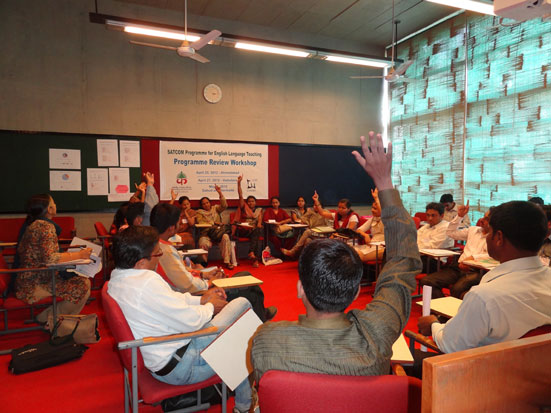
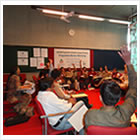
| The second phase of the Teaching English Language for schools in scheduled areas of Gujarat was initiated w.e.f. August 2011. Five Programme Review Workshops were held for the five different types of schools being covered under the project in which there were 140 participants Teachers shared that the viewership of the programme had increased; students had also begun to show more interest in the programme; SATCOM Fellows who were appointed in the previous phase to support schools played a very positive role in resolving technical issues and enhancing viewership. Ashramshala Adhikaris and Vigilance Officers also participated and gave their suggestions to improve programmatic |
 |
|
| aspects, especially its monitoring. A draft report has been prepared based on the findings of the monitoring done by the SATCOM Fellows and the team. A seven day workshop was conducted in April with the Academic team and the Advisor to discuss, script and finalise classes 17-30 of the std. IX package. Based on these scripts, recording of the package was done. Based on the finalized sessions and worksheets, recording of activities for classes 17-30 and class anchorages was completed during this period. Graphics for these recordings were visualized and sets were developed based on this visualization. The team is in the process of editing these classes. Classes 1-16 have been finalized. Illustrations and layouts of worksheet 17-30 were completed and workbook 2 of the standard IX learning package has been formatted and finalized. |
| |
|
| |
|
|
|
|
|